Commands#
Commands specify what the policy should achieve at each moment: a target velocity, a reference trajectory, a goal position. The command manager generates these signals, resamples them at configurable intervals, and passes them to the policy through the observation system.
Registration#
Commands are registered in ManagerBasedRlEnvCfg as a dictionary
mapping string names to CommandTermCfg instances. Unlike the
function-based terms used by other managers, every command term is a
class that inherits from CommandTerm.
The resampling_time_range field controls how often the command
changes. After each resample the term draws a new timer value uniformly
from the given (min, max) range in seconds. Commands are also
resampled unconditionally on every episode reset.
commands = {
    "twist": UniformVelocityCommandCfg(
        entity_name="robot",
        resampling_time_range=(3.0, 8.0),
        ranges=UniformVelocityCommandCfg.Ranges(
            lin_vel_x=(-1.0, 1.0),
            lin_vel_y=(-1.0, 1.0),
            ang_vel_z=(-0.5, 0.5),
        ),
    ),
}
The generated_commands observation function reads the current
command tensor by name and passes it to the policy:
ObservationTermCfg(
    func=mdp.generated_commands,
    params={"command_name": "twist"},
)
If the environment has no commands, the manager no-ops all operations and returns empty tensors. There is no special handling required.
Included command terms#
Each task ships with its own command terms tailored to its objective.
Term |
Description |
|---|---|
|
Generates planar velocity commands |
|
Generates a 3D target position for a manipulated object. Supports fixed and dynamic difficulty modes. Tracks metrics including position error and episode success rate. Used by the manipulation task. |
|
Streams reference joint positions, velocities, and body poses
from a pre-recorded |
Each term can render debug visualizations in the interactive viewer
when debug_vis=True is set in the configuration. The image below
shows the ghost visualization from MotionCommand, which renders a
translucent copy of the robot at the reference pose alongside the
actual robot.
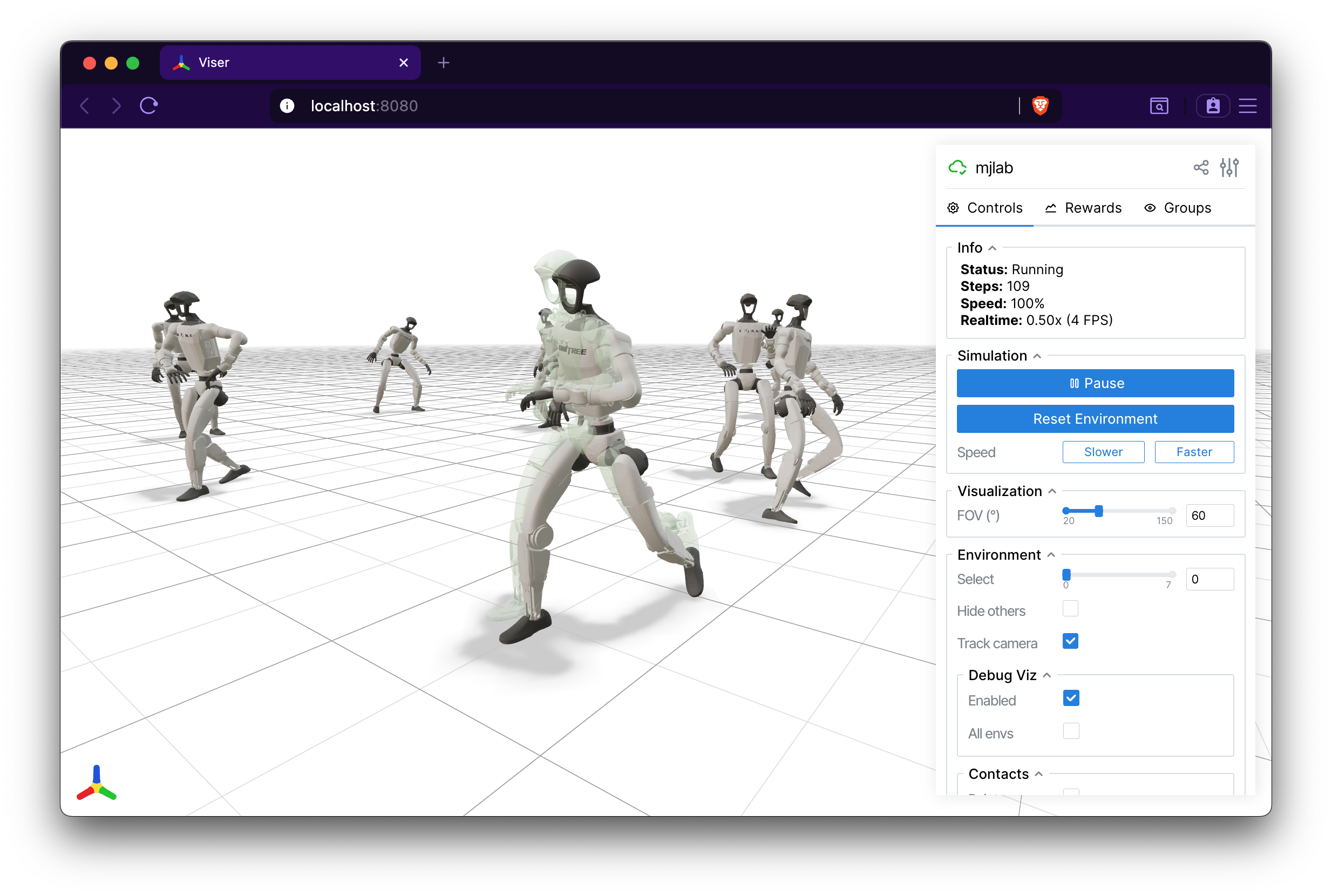
Viser visualization of the commanded reference motion for the G1 tracking task.#
Writing custom command terms#
A custom command term is a class inheriting from CommandTerm paired
with a configuration dataclass inheriting from CommandTermCfg. The
term must implement four methods: _resample_command(env_ids) to
sample new goals, _update_command(env_ids) for per-step updates,
_update_metrics() for logging, and a command property returning
the current goal tensor. The base class manages the resampling timer
and reset logic automatically.
_update_command is called in two situations. On every environment
step it receives env_ids=None, meaning update all environments.
After a reset it is called again with the ids of the environments that
were just reset, so their command state is brought up to date before
observations are computed.
The distinction matters when your update advances state, such as
incrementing a frame index into a reference motion. Apply such advances
only to env_ids (all environments when None); otherwise
resetting a few environments would also advance every other one. Updates
that simply recompute values from the current simulation state, like a
heading error, give the same result no matter how often they run and can
safely ignore env_ids.
The configuration must implement a build(env) method that
constructs the paired term instance.